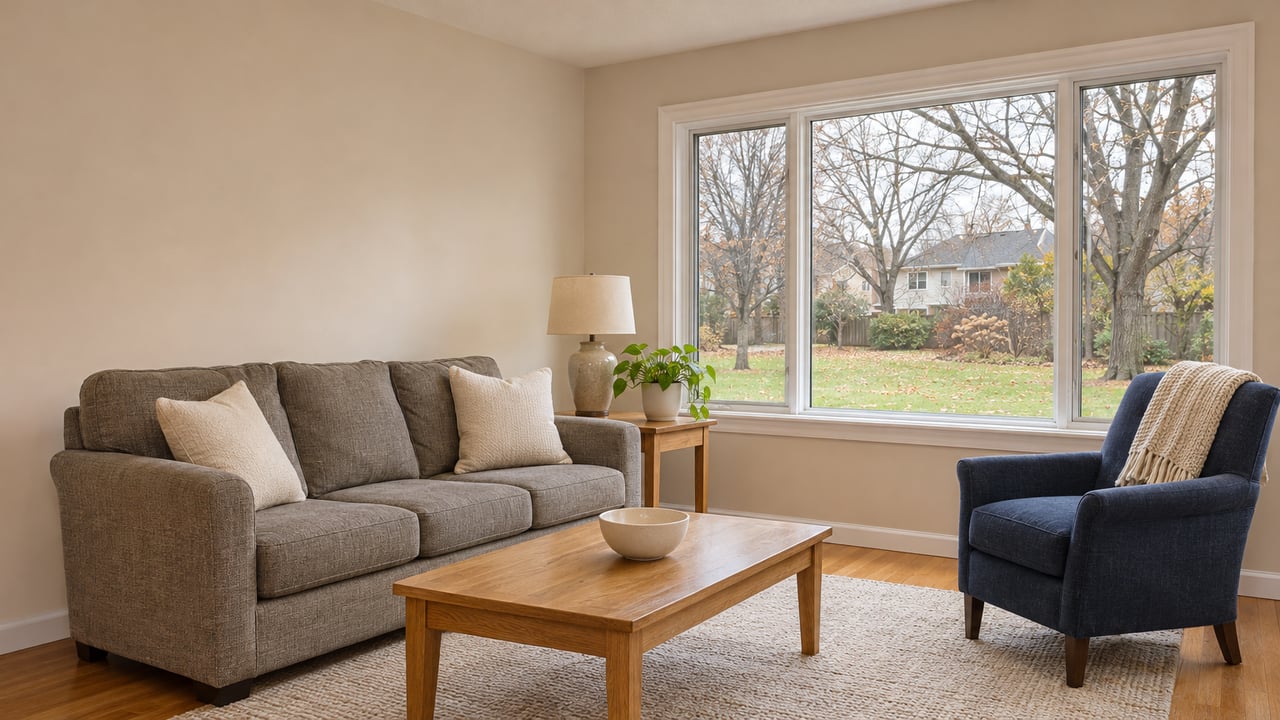
What Apple Valley's Fall Listing Jump Means for Buyers
November 19, 2026
November 19, 2026
In September 2026, Apple Valley had 183 homes for sale, up from 108 in September 2025. That is a 69.4% increase, and the homes that sold that month still brought sellers 98.1% of their original asking price. Both numbers are correct, and they fit together once you see where Apple Valley started. A year ago it was tighter than Burnsville, Eagan and Dakota County as a whole. This fall, it reached the level the rest of Dakota County was already at. For a buyer comparing Apple Valley with Lakeville, Rosemount or Eagan, that changes what to expect at the negotiating table.
Inventory rose across the Twin Cities this year, but Apple Valley's increase was much larger. In September 2026, the 16-county Twin Cities region had 11.2% more homes for sale than a year earlier. Burnsville was up 21.8%, Eagan 13.4% and Dakota County as a whole 25.6%. Apple Valley's 69.4% was close to three times the county's rate.
Months of supply puts Apple Valley's jump next to its neighbors on the same scale. All figures in the table are for September 2026, from the Minneapolis Area REALTORS Local Market Updates current as of Oct. 7.
| September | Months of supply, 2025 | Months of supply, 2026 | Median sale price, Sept. 2026 | Share of original list price received, Sept. 2026 |
|---|---|---|---|---|
| Apple Valley | 1.9 | 3.4 | $400,000 | 98.1% |
| Dakota County | 2.8 | 3.4 | n/a | n/a |
| Twin Cities region | 2.9 | 3.2 | $395,000 | 97.7% |
| Burnsville | 2.4 | 2.8 | $379,500 | 98.0% |
| Eagan | 2.4 | 2.7 | $420,000 | 97.8% |
In September 2025, Apple Valley had 1.9 months of supply. That was lower than every comparison area in the table, and the county stood at 2.8. A year later, Apple Valley and Dakota County both stood at 3.4. Apple Valley's large percentage jump came mostly from its low starting point. The city went from scarce to about average for its county. It is now a little looser than Burnsville and Eagan, and still well short of the five to six months that Minnesota Realtors calls a balanced market.
One month can look extreme in a city this size, and the reports carry that warning themselves. The 12-month totals show this is more than a one-month swing. For the 12 months through September 2026, Apple Valley had 970 new listings, up 19.6% from 811 the year before. Closed sales over the same 12 months fell 3.7%, from 680 to 655.
That works out to about 1.5 new listings for every closed sale over the past 12 months, up from about 1.2 the year before. Buyer demand didn't fall much. More owners decided to sell while the number of buyers stayed about the same, and the gap built up as homes waiting for buyers. The same pattern ran statewide. The joint Oct. 16 release on September data from the Saint Paul Area Association of REALTORS, Minneapolis Area REALTORS and Minnesota Realtors said "Sellers kept coming." Twin Cities pending sales, which signal future closings, fell 11.7% that month as the average 30-year fixed mortgage rate climbed from about 6.7% in August to 7.4% on Oct. 8. The rate has eased slightly since then. Freddie Mac's weekly survey put it at 7.11% for the week of Nov. 12, down from 7.18% the week before.
Prices are the confusing part. Apple Valley's September median was $400,000, up 1.1% from $395,750 a year earlier. The 12-month median held at exactly $380,000. Homes that sold in September went under contract in 41 days on average, slightly faster than the 43 days a year earlier.
Two details in the same report explain how prices can hold while supply nearly doubles. The first is that every price measure counts only homes that sold. The 98.1% of original list price describes the 61 homes that closed in September 2026. It says nothing about the homes still listed. When inventory grows this much and closings don't, the extra supply shows up as more homes waiting, not as lower prices on the homes that sell. A home priced right for the neighborhood can still sell close to its asking price in this market.
The second is the mix of homes that sold. In September, the average sale price rose 6.1% to $412,101, while the median price per square foot fell 2.1%, from $191 to $187. When the average price rises and the price per square foot falls in the same month, larger homes likely made up more of the sales. Without that mix shift, the September median gain might have been flatter.
The price figures in these reports also leave out seller concessions. If a seller in Apple Valley covers some closing costs or credits the buyer for a repair, the recorded sale price doesn't change. Minnesota Realtors President Wendy Uzelac said in that October release that buyers now have "more room to negotiate and more room to request repairs or concessions." Most of the buyer's gain this fall will happen in terms like those, so the headline numbers won't show it.
Buyers deciding among south metro cities often compare Apple Valley with Lakeville and Rosemount. All three got looser this year, and they now sit at different points.
In September 2026, Lakeville's median sale price was $515,000, with 4.3 months of supply and 97.4% of original list price received, and homes sold in an average of 49 days. Rosemount's median was $417,000, with 4.2 months of supply. Homes sold in an average of 57 days, and sellers received 96.7% of original list price, down 1.1 points from a year earlier. Apple Valley had less supply than either, faster sales and a higher share of list price. Its median was $115,000 below Lakeville's and $17,000 below Rosemount's.
If you're comparing these three, a $400,000 budget in Apple Valley still faces a bit more competition than the same budget in Rosemount. Compared with a year ago, though, you have more homes to choose from and a little more time to decide. Our Lakeville post on its housing moratorium explains why that city's supply has grown even with new applications paused.
The two residential projects in the City of Apple Valley's June 2026 community development newsletter are an apartment building and a senior living addition. Orchard Place Apartments at 15665 English Avenue adds 135 market-rate units. The project also includes a rebuilt North Creek Greenway trailhead with a plaza, gazebos, pergolas and seating, and the city estimated the whole project would be finished in November 2026. Phase 3 of Orchard Path Senior Living at 15971 Cobblestone Lake Parkway South adds 75 independent-living units, with completion estimated for this fall.
A person moving into Orchard Path or a renter signing a lease at Orchard Place may or may not be selling a house nearby. Nothing reported so far ties those projects to the added listings. They are a reason to ask how long a listing has been on the market and why the owner is moving. If you're thinking about moving to Apple Valley, our Apple Valley neighborhood page has more on the city.
The September reports suggest a buyer in Apple Valley right now has more choices and more time than a buyer did in September 2025. Prices haven't fallen to match. Homes priced right for their block are still selling close to asking. With 3.4 months of supply, it is reasonable to look at more than one home before making an offer, to pay attention to homes that have been listed a while, and to ask for inspection repairs or help with closing costs on homes that haven't drawn offers. Expect most of the savings to come from terms like those. The sale price itself is likely to stay close to list.
Sellers face the same numbers. With supply at the county average, buyers have more homes to compare against, so the asking price has to be right from the first day. Aarica Coleman, president of Minneapolis Area REALTORS, said in the same joint October release that slower sales give sellers "a good reason to price realistically from day one." If you own in Apple Valley and want to know how your home compares with what's listed now, a home valuation is a good place to start.
Mortgage rates and market figures in this post are general information, not financial advice. Please check your own numbers with a lender or financial professional before you make an offer.
If you're comparing Apple Valley with Lakeville, Rosemount or somewhere else in the south metro and want to know how a specific listing fits these September numbers, I'm happy to go through it with you, including how long the home has been listed and what kind of offer makes sense. Reach out through Tom Bullington Homes, and let's connect.
I bring a wealth of knowledge and expertise about buying and selling real estate here. It's not the same everywhere, so you need someone you can trust for up-to-date information. I am eager to serve you.